Difference between revisions of "The Authority of the Bible (For Teens)"
(→Sixty-Six Books?) |
(→The Purpose) |
||
| Line 191: | Line 191: | ||
** | ** | ||
<br> | <br> | ||
| + | |||
| + | ==Translation== | ||
| + | We could spend weeks on translation. What we need to know is that the Bible was originally written in Hebrew, Aramaic, and Greek. These three languages are very well known and translators have the ability to translate these very well. | ||
| + | |||
=Conclusion= | =Conclusion= | ||
*If the Bible is a reliable authoritative book, what does that mean for you? | *If the Bible is a reliable authoritative book, what does that mean for you? | ||
Revision as of 17:48, 14 September 2018
Authority of the Bible Handout
Objectives
- Students will trust the authority of the Bible.
- Students will be aware of some challenges to Biblical authority and be prepared to face those challenges.
- Students will see the Bible as authoritative in their life.
Introduction 1
- What have you always wanted to know about the Bible and its authority?
Introduction 2
- What are some ways that people "know" something is true?
- Test it with the scientific method.
- Observe something
- Read about an account is certainly a valid way of knowing but don't bring this one up unless some of the teens bring it up.
- What are the steps of the scientific method?
- Ask a Question:
- Do Background Research:
- Construct a Hypothesis:
- Test Your Hypothesis by Doing an Experiment:
- Analyze Your Data and Draw a Conclusion:
- Repeat
- What are the limitation of the scientific method?
- The scientific method is often cited as the gold standard for knowledge and is certainly an important aspect of knowledge, but not everything that can be know can be known through the scientific method. For example, historical events happen in very particular times in particular contexts, involving particular people. Many historical events are non-repeatable and fundamentally cannot be known through the scientific method.
Apologetics = Defending Our Faith
- Why do you believe the Bible?
Main Body
Trustworthiness
Scripture's Own Attestation
- What do 2 Timothy 3:16 and 2 Peter 1:20-21 say about scripture?
- What does Titus 1:2 teach us about the one who inspired scripture?
Archaeological Evidence
Archeological evidence abounds. In this discussion we will only cover a few examples. What is important to understand is that the field of archaeology only continues to confirm the Bible.
- What even is described in 2 Samuel 7? (In particular 2 Samuel 7:16 provides a nice summary statement).
- The Tel Dan Stele
- The upright stone confirms the house of David and Davidic dynasty.
- The Tel Dan Stele
- What major construction project did King Hezekiah undertake in 2 Kings 20:20?
- The curving Siloam tunnel is 533 m long, and by using the 30 cm altitude difference between its two ends, water can be moved from the Gihon spring to the pool of Siloam. This would have provided the city water during the siege of Jerusalem.
- Whose name is mentioned in Acts 18:12-17?
- The Gallio Inscription
- a collection of nine fragments of a letter written by the Roman emperor Claudius that specifically mentions Gallio the proconsul.
- The Gallio Inscription
We must understand that no amount of archaeology could ever prove the Bible, in large part, because Archeology cannot prove anything. However, archeology gives us insight and perspective on how careful the biblical authors were when they wrote the inspired word of God.
Transmission
Scholars use the term "autograph" to refer to the original manuscripts.
The Originals are Inspired-not the copies. What a lot of Christians don't know is that the autographs (original writings) are inspired--not the copies. The autographs are the original writings--the original documents penned by the biblical writers. The copies are copies of inspired documents. The copies are not themselves "inspired"; that is, they have no guarantee of being 100% textually pure. But don't worry, the Bible manuscripts are 98.5% textually pure. Only a very small amount of information is in question because we have repetitive facts, instructions, and information found elsewhere in the Bible. Nevertheless, through the copying method over the years, various textual problems have arisen. Following is a list of the types of errors that have occurred in copying the manuscripts. I've used English as examples instead of going into the original languages for examples.
Dittography - Writing twice what should have been written once. Example: writing "latter" instead of "later." "Latter" means nearest the end. "Later" means after something else. Fission - Improperly dividing one word into two words. Example: changing "nowhere" into "now here." Fusion - Combining the last letter of one word with the first letter of the next word. Example: "Look it is there in the cabinet . . . or Look it is therein the cabinet." Haplography--Writing once what should have been written twice. Example: "later" instead of "latter." "Later" means after something else. "Latter" means nearest the end. Homophony - Writing a word with a different meaning for another word when both words have the exact same pronunciation. Example: Meat and meet have the exact same sound but different meanings. Also, there and their and they're are another example. Metathesis - An improper exchange in the order of letters. Example: Instead of writing "mast," someone writes "mats," or "cast" and cats." Does this mean we cannot trust the Bible? Does this mean that the Bible we hold in our hand is not inspired? Not at all. Inspiration comes from God; and when He inspired the Bible, it was perfect. Our copies of the original documents are not perfect, but they are very close to being so. The critics often erringly assume that even the copies are supposed to be perfect. But when we point out that God never said the copies would be perfect, they then ask how can the Bible be trusted at all? Quite simply, it is redundant in its facts and information; and the amount of material that has any variation at all is so minute compared to the whole Bible that the Bible is considered to be almost 100% accurately copied. Furthermore, the copyist errors present no problems doctrinally.
- If you want to make a copy of a text. What do you do today?
- Mass printing was not really invented until 1439. Prior to this point Scripture was copied by hand. How reliable were these copies? The discovery of the Dead Sea Scrolls in Qumran in 1946 were revolutionary because the copies of the Old Testament dated nearly 1000 older than anything previously known. Furthermore, these manuscripts were found to be nearly identical. In other words, 1000 years of copying scripture had introduced nearly no changes. God has preserved his word.
- What promise is made in Isaiah 40:8?
The textual evidence for the New Testament is no different.
Still, some will say that since there are, for example, copyist errors then we must throw out the entire Bible. But this argument is very weak. Are we to throw out a science textbook because there is a misspelled word or two in it? Does this mean that the whole book cannot be trusted? Of course not. Furthermore, compared to other ancient documents, the New Testament, for example, has far more textual evidence in its favor than any other ancient writing. Please consider the chart below.
| Author | When Written | Earliest Copy | Time Span | No. of Copies |
|---|---|---|---|---|
| Homer (Iliad) | 900 BC | 400 BC | 500 years | 643 |
| Ceasar (The Gallic Wars) | 100 44 BC | AD 900 | 1000 years | 10 |
| Plato (Tetralogies) | 427 347 BC | A.D. 900 AD | 1,200 years | 7 |
| Aristotle | 384-322 BC | A.D. 1,100 | 1,400 years | 49 |
| Herodotus (History) | 480 425 BC | A.D. 900 | 1,300 years | 8 |
| Euripedes | 480-406 BC | A.D. 1,100 | 1,500 years | 9 |
| New Testament | A.D. 50 90 | A.D. 130 | 30 years | 24,000 |
If the Bible cannot be trusted as being reliable because it has only a small percentage of copyist errors, then neither can the above documents that have far less textual support be trusted. In other words, the critics (to be consistent) would have to reject the Iliad, The Gallic Wars, Plato's Tetralogies, Aristotle's works, Hoerodetus' history, and Euripedes' writings. Are the critics willing to disregard all those writings--which are far less well preserved--if they throw out the Bible as being reliable? They should if they are fair in how they apply their criticism. Since basically no one discards those writings as being so bad that they can't be trusted, why would anyone apply the double standard to the Bible . . . unless they have an agenda.
We can see that the Bible is an ancient document that has withstood thousands of years of transmission with remarkable accuracy and clarity--far more so than the great works of old listed in the chart above. We can trust it to be what it says it is: the word of God.
The Canon
Original Authors
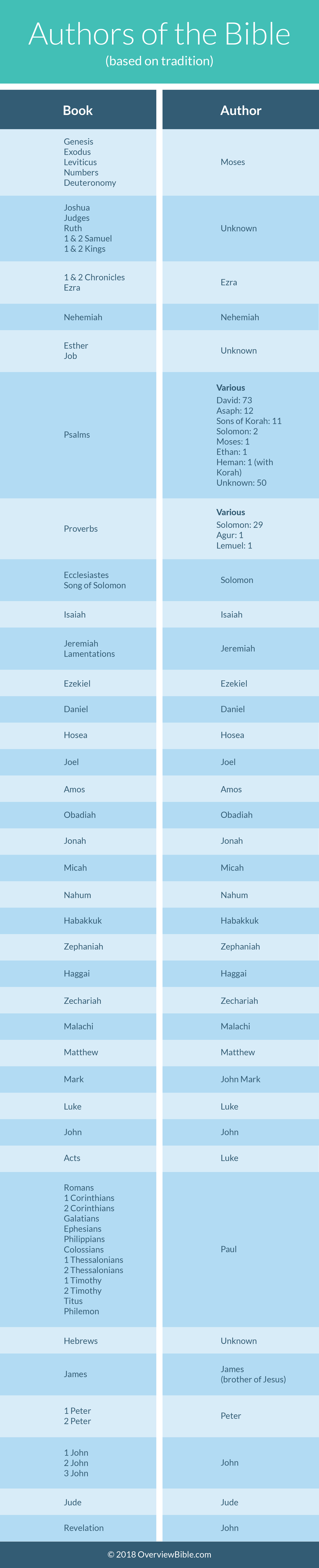
Break into groups and ask them to work on the following questions. Ideally this can be done on Posters or something that can be hung up. If possible you may want to provide commentaries, study Bibles, or some other resource that identifies authors of books of the Bible.
- Who wrote the various books of the Bible?
The following handout may be useful Authorship of the Bible
Sixty-Six Books?
- How would you respond if someone told you "You know, the Bible that you have is only part of the Bible. There is actually a lot more of the Bible you just don't know about?"
- What did Christ have to say about the Old Testament in Matthew 21:42?
- How does Matthew 23:35 show that the no books should be added to the Old Testament?
- What does Colossians 3:16 say about scripture?
- What does 1 Thessalonians 5:27 say about Paul's writing?
- What did Peter have to say about Paul's writing in 2 Peter 3:1, 2, 15, 16?
- The canonization of the sixty-six books we have can be summarized in two key components. The Old Testament we use is identical to the Old Testament that Jesus used and there is really no historical question about this. In fact, John 7:15 makes it clear that the Old Testament Canon was very important to Christ. It was not until much later in history that the Roman Catholic Church added some books to the Bible so that they could defend some of their more controversial doctrines. So the answer is that the Old Testament that we use is the Old Testament that Christ endorsed.
- Second, there are other books written early in the church age that discuss religion, but that does not make them the Bible. When the churches chose texts for the Bible they were very careful to ensure that books met a very high standard.
- Apostolicity - Can we trace the book to an apostle of Christ?
- Antiquity - Was the book written at the time of the apostles?
- Orthodoxy - Does the book actually correspond with the doctrine of the apostles?
- Trustworthiness - Does the book fit with historical reality
- Usage - Was the book used by early churches?
- Could not The Holy Spirit who inspired the scripture also superintend the selection of which books should be scripture?
The Purpose
- According to 2 Timothy 3:16, what is the Bible useful for?
Translation
We could spend weeks on translation. What we need to know is that the Bible was originally written in Hebrew, Aramaic, and Greek. These three languages are very well known and translators have the ability to translate these very well.
Conclusion
- If the Bible is a reliable authoritative book, what does that mean for you?
- Be specific, what does this mean for you tomorrow?
- What does this mean for your interactions with others?